
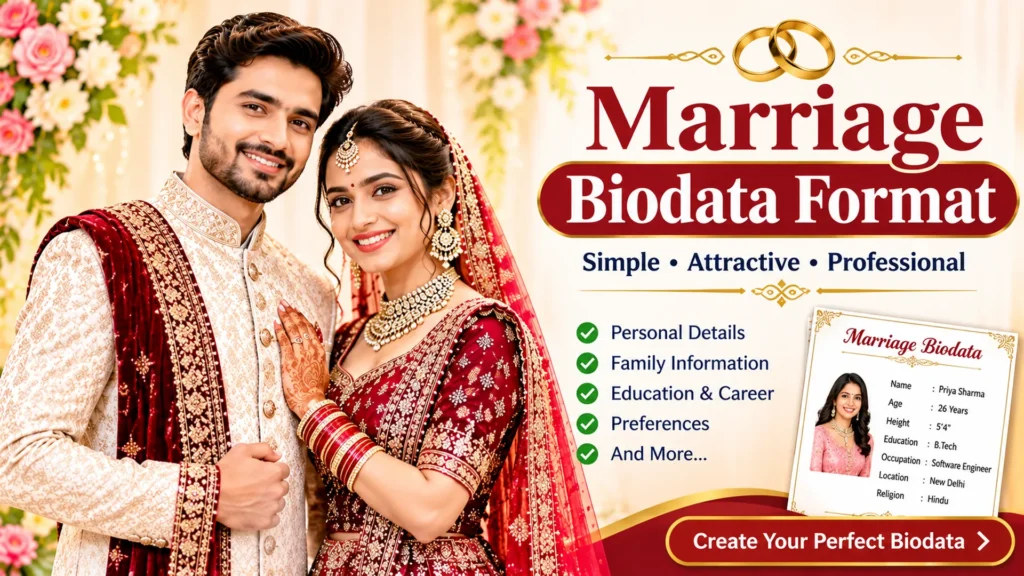
A well-designed marriage biodata is an important part of the matrimonial journey. It introduces you to prospective life partners and their families by presenting essential information about your personality, education, profession, family background, and expectations from married life. Choosing the right marriage biodata format helps you organise these details clearly and create a positive first impression.
Whether you are preparing a biodata for yourself, your son, your daughter, or another family member, having a suitable format makes the process easier. Today, you can choose from traditional, modern, elegant, and premium designs to create a biodata that reflects your personality and preferences.
What Is a Marriage Biodata Format?
A marriage biodata format is a structured layout used to present an individual’s personal and family information for matrimonial purposes. Unlike a professional resume, it focuses on personal background, educational qualifications, occupation, lifestyle, family values, and partner preferences.
A good bio data format for marriage makes important information easy to find and understand. It also helps prospective partners and their families get a better idea of an individual’s background before taking the marriage discussion forward.
Important Details to Include in a Biodata Format
A well-organised biodata format should contain all the relevant information without making the document unnecessarily lengthy. Here are the essential sections to include:
1. Personal Information
Start with basic details that introduce the individual. These may include:
- Full name
- Date of birth and age
- Height
- Marital status
- Religion and community, if relevant
- Mother tongue
- Current city and country
2. Educational Qualifications
Mention your highest educational qualification, college or university, area of specialisation, and additional certifications, if relevant. These details help prospective families understand your academic background.
3. Professional Details
Include your current occupation, company or business, job designation, and professional achievements, if applicable. You may also mention your work location and career aspirations.
4. Family Background
Family information provides insight into an individual’s upbringing and family environment. You can include your father’s and mother’s occupations, number of siblings, family type, family values, and native place.
5. Hobbies and Personal Interests
Add a few details about your personality and lifestyle. You may mention interests such as travelling, reading, cooking, music, fitness, sports, or spending time with family.
6. Partner Preferences
This section helps communicate expectations from a future life partner. You can mention preferred age range, educational qualifications, profession, location, lifestyle, and family values.
Popular Marriage Biodata Templates
Choosing the right marriage biodata template is just as important as including accurate information. Your design should be attractive, readable, and appropriate for your personal preferences.
Here are some popular styles:
- Traditional Biodata Format: Features classic colours, simple layouts, and essential personal and family details. Suitable for individuals who prefer a traditional presentation.
- Modern Biodata Format: Uses clean typography, structured sections, and contemporary design elements.
- Elegant Biodata Format: Combines subtle colours, attractive fonts, and balanced spacing for a sophisticated appearance.
- Premium Biodata Format: Offers refined layouts, dedicated photograph sections, and beautifully organised information.
- Minimalist Biodata Format: Focuses on simplicity and highlights important details without unnecessary decoration.
Choose a template that represents your personality while keeping the information easy to understand.
Tips for Creating an Impressive Marriage Biodata
Before sharing your biodata with prospective matches, follow these practical suggestions:
- Keep information accurate: Check all personal, educational, professional, and family details.
- Use a suitable photograph: Include a clear and recent photograph if you are comfortable sharing one.
- Maintain a clean layout: Use readable fonts, consistent spacing, and clear headings.
- Highlight important details: Make your education, profession, and family background easy to find.
- Avoid unnecessary information: Focus on details that are relevant to a matrimonial introduction.
- Protect your privacy: Avoid including exact residential addresses or sensitive financial information.
Create Your Marriage Biodata Online with BiodataMaker
Creating a marriage biodata from scratch can take time, especially if you are unfamiliar with document designing. BiodataMaker makes the process easier by offering professionally designed templates that you can customise according to your preferences.
Simply choose a suitable marriage biodata format, enter your personal and family information, select your preferred design, and prepare a personalised document. You can explore different styles and create a biodata that is ready to share with prospective matches and their families.
Whether you prefer a traditional layout or a modern design, the right marriage biodata format helps present your information in a clear and attractive way.
Your marriage biodata is more than a collection of personal details. It is your introduction to a potential life partner. Choose a suitable template, share genuine information, and create a profile that reflects your personality, values, and expectations for the future.